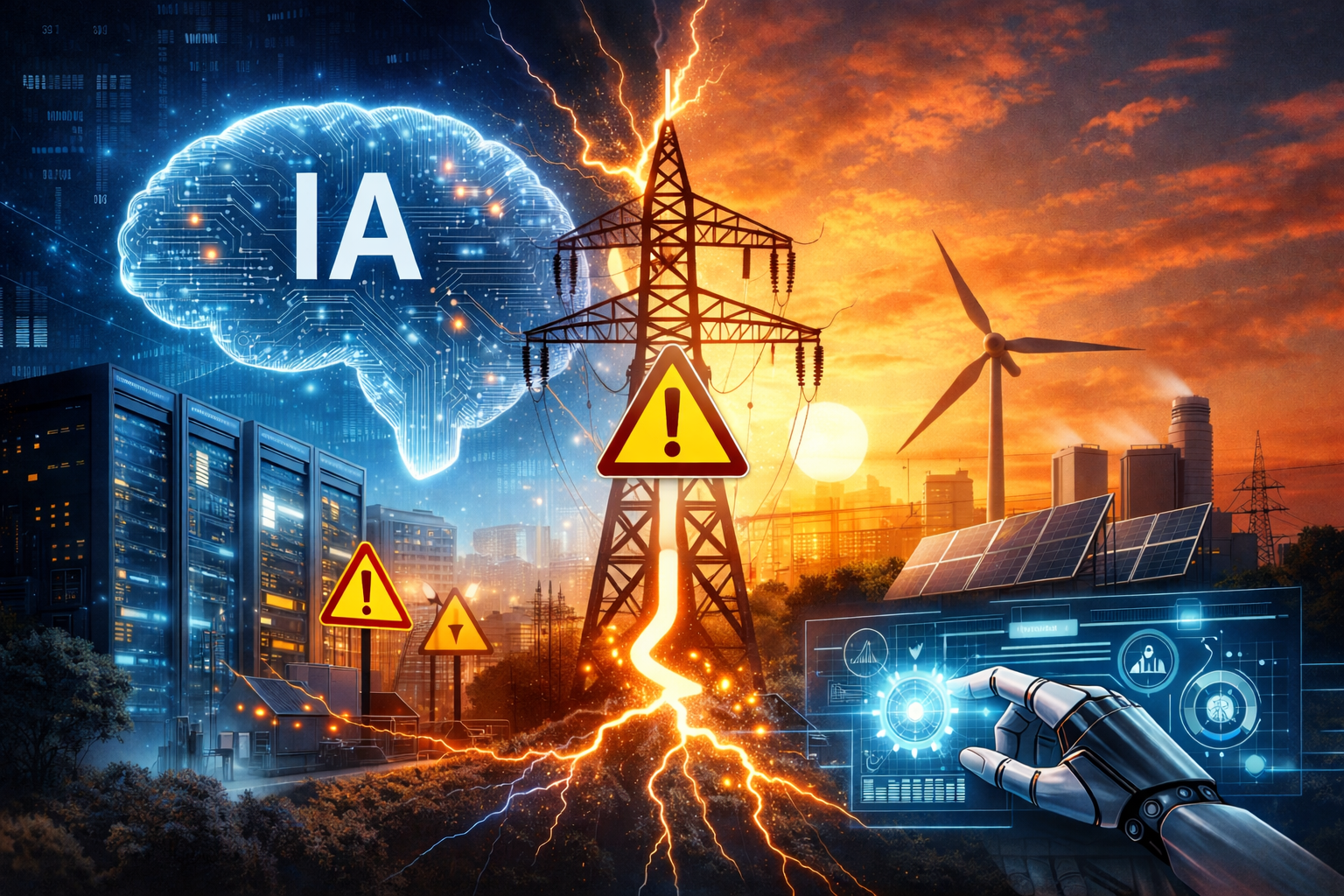

The accelerated expansion of artificial intelligence is testing the electrical system. Not so much in terms of the amount of energy it requires, but in terms of the system’s ability to integrate a new, concentrated and intensive demand.
When discussing the energy footprint of artificial intelligence, the debate often begins with a deceptively simple question: how much electricity does it consume? This quantitative view, however, hides the real challenge. The problem is not just how much is consumed, but where, when and with what intensity, and how this strains an electrical infrastructure designed for a different pace and geography of demand.
Global forecasts clearly point to a shift in scale. According to the International Energy Agency, data center electricity consumption could more than double by 2030. But the truly critical factor is not just annual TWh, but power density. The new AI racks deliver ten times more power per unit of space than traditional data centers, requiring much more robust electrical connections and increasingly complex cooling systems.
This demand, moreover, is not distributed homogeneously. It is concentrated in very specific areas, generating “hot spots” that strain the network to the limit. The problem is not global, it is geographical and temporal.
A speed mismatch
Here, a structural mismatch appears between two worlds that advance at very different rates. The digital world can design and build a data center in two or three years; on the other hand, reinforcing a substation or extending a power line can require between four and eight years, including permits, procedures and civil works. When these schedules do not fit together, infrastructure systematically falls behind, while demand increases.
This phenomenon is already having visible consequences. On a global scale, a significant portion of data center projects are at risk of indefinite delay simply because the network does not arrive on time.
The case of Spain: lots of energy, little network
Spain is a clear example of this tension. In 2024, the electricity system received access and connection requests for more than 67 GW of new demand, but only a small part was ultimately granted. In the case of data centers, the blockage is even more evident: almost all demand has been denied or pending.
The problem is not the lack of generation. Spain has enough renewable projects. The real bottleneck is the distribution network, with a large majority of nodes already saturated. The infrastructure was not sized to simultaneously absorb the electrification of demand, the deployment of renewables and the accelerated rise of AI.
In short, the main limit is not the availability of energy, but the capacity of the network to absorb and distribute new demand where it is concentrated.
The industry’s response
Faced with this scenario, the industry’s reaction is pragmatic. When connecting to the grid becomes uncertain and slow, data center models with partial or total energy autonomy gain weight: self-generation, microgrids, co-location with renewables and storage systems.
At the same time, the debate on stable and continuous energy sources, such as nuclear power or small modular reactors, has resurfaced. However, these solutions are unlikely to arrive in time to resolve current bottlenecks; their role, if they do arrive, will be more relevant in the medium term.
AI can also be part of the solution
Reducing the debate to “AI consumes too much” is short-sighted. Because AI is not only part of the problem, but also a key tool for managing the complexity of the energy system.
Digitalization allows us to anticipate congestion, optimize flows and extract more performance from existing infrastructure. Some digital loads can become more flexible over time, adapting to renewable availability and acting as a kind of “virtual battery”. In addition, AI is accelerating innovation in materials, batteries and industrial processes, drastically reducing development times.
There are even science fiction-like proposals, such as placing computing capacity in orbit powered by constant solar energy. These are not imminent solutions, but they clearly indicate that the physical limits of the Earth system are already a real constraint.
Ultimately, the key question is not whether AI will consume more energy – it is inevitable – but whether we will be able to fit this growth into an electricity system in full transformation. And here the message is clear: the bottleneck is not just generation, but the grid and the way we use it.
At ERIA, this intersection between network, flexibility, storage and digitalization is key. The energy future also involves operating the system better and turning the new digital demand into an ally of the energy transition.