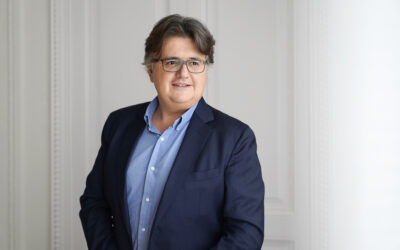

Ana Simon is Manager of Disruption and Open Innovation at ACCIO, the agency for business competitiveness of the Generalitat de Catalunya. In her role, she works to connect corporations, startups and technology centers with the aim of accelerating the adaptation of the productive fabric to major disruptive changes. From ERIA we talk to her about the role of ACCIO within the Catalan ecosystem, the challenges of open innovation and what Catalonia needs to make the leap towards being the leading European regions in innovation.
1.How would you define the role of ACCIO within the Catalan innovation ecosystem?
Catalonia is a “Strong Innovator” region according to the European Commission, with a dynamic technological ecosystem and a solid scientific base. But the global context has accelerated: green transition, digitalization, AI and international competition are redefining the rules of the game.
In this scenario, ACCIO is a structural piece of Catalan competitiveness. It acts as an orchestrator and connector between business, technology, capital and global markets. It is not only business support, but an instrument of economic policy oriented towards impact: transforming innovative capacity into real competitive advantage. Its differential value is to combine territorial proximity, transversal vision and international connection.
2.How is open innovation promoted from a public institution and what impact does it have?
Open innovation is no longer a strategic option, it is a structural necessity. 68.9% of innovative Catalan companies collaborate to innovate (ACCIO Barometer 2025). But today the key is not just to innovate, but to adapt continuously: the pace of business change has almost quadrupled since 2019 (Accenture).
At ACCIO we understand open innovation as a mechanism for accelerated adaptation. We open companies to emerging technologies, connect with startups, facilitate pilots with funding and support scaling with local, state and European partners and funds. In essence, it is an architecture to increase the speed of adaptation of the productive fabric.
3.What percentage of companies practice open innovation? And what is needed to expand it?
68.9% of innovative companies collaborate. Large corporations tend to structure open innovation more; SMEs often innovate more informally.
The challenge, in a country of SMEs, is to expand the base of companies that innovate on a recurring basis. It is necessary to reduce complexity, support in the definition of the first challenge, reduce risk with proofs of concept and facilitate tools (such as AI) to identify solutions and partners. Large companies have understood the model; their challenge is to scale. The country’s is to make open innovation a cross-cutting culture.
4.Main barriers for large companies?
The main barriers are not technological, but organizational: lack of clear leadership, disconnection with the business, fear of legal or reputational risk.
At ACCIO we help define challenges aligned with the strategy, connect with the ecosystem and support pilots and scaling with financing. It’s about reducing risk and facilitating real implementation.
5.Is open innovation only for large corporations?
No. It is also essential for SMEs, which often innovate in a more intuitive, less structured way, with more limited resources. Catalonia is an SME economy: this gives flexibility, but less financial muscle. Open innovation allows access to technology, talent and capabilities that individually could not develop. The challenge is to reduce the cost and risk of collaborating.
6.What trends will mark the future of open innovation in the coming years?
The ability to adapt will be more relevant than ever. What is a competitive advantage today may cease to be so in months.
The great disruption has a name: artificial intelligence. 24% of Catalan companies with more than 9 employees have already incorporated AI (Barometer 2025), but we are only in the first phase. Competitiveness is no longer just productivity, but continuous technological adaptation and generation of new value. The public sector must create conditions to experiment and scale more quickly.
7.What do successful projects have in common?
Clear leadership, well-defined strategic challenge, business involvement, dedicated resources, impact measurement and a focus on scalability.
Successful organizations know how to manage the current business while building the next one. Being in the present with an eye on the future.
8.What common mistakes do companies that start working with open innovation make?
Treating open innovation as a fad or one-time action, launching vague challenges, not involving the business, doing pilots without thinking about scaling or expecting immediate results.
Without governance and a vision for implementation, it remains an experiment. With method and commitment, it becomes real growth.
9.What skills are key to leading transformation processes?
Uncertainty management, critical and systemic thinking, technological understanding (especially AI) and humility to constantly learn.
10.What separates us from the “Innovation Leaders” regions?
We have a solid foundation, but leading regions combine high private investment in R&D, large global corporations and very fluid transfer systems.
The leap requires dimension, investment and scale: more business R&D, stable collaboration, industrial scaling, regulatory simplification and high-impact driver projects.
11.How do you imagine the Catalan ecosystem in a few years?
More international, more technological (AI and deep tech integrated), more collaborative and more oriented towards social and green impact. With leadership potential in health, biotechnology and green transition.
Above all, an ecosystem that understands that the value is not just innovating, but in continuously adapting. The public sector will have to act increasingly as an ecosystem architect.
12. What role can ERIA play?
If the public sector evolves into an ecosystem architect, private actors are needed to mobilize capital and assume technological risk. ERIA, Estabanell’s corporate venturing vehicle, can be a key player especially in the field of energy transition.
We need more corporations that not only innovate internally, but also actively invest in the ecosystem and connect innovation with the real market. Precisely for this ability to combine innovation, investment and impact, Estabanell —through ERIA— was recognized as a Catalonia Exponential Leader 2025: a program that identifies Catalan companies that lead disruptive transformations with global ambition (2026 call open until March 6!).