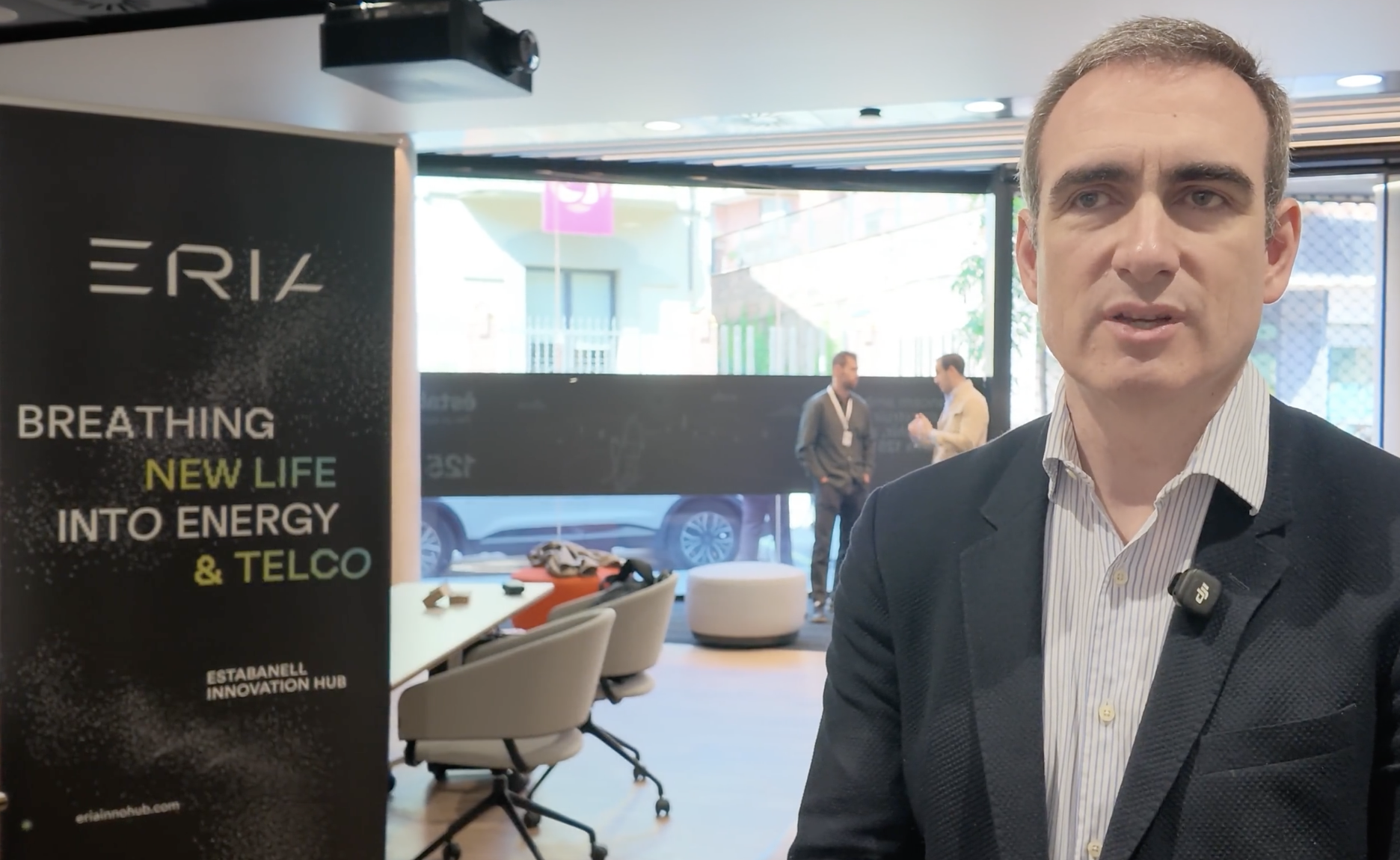

At ERIA, we spoke with Rafael Riquelme, head of Loradix, a Madrid-based startup specializing in connectivity and energy microflexibility in the home. The company aims to leverage the communications infrastructures of power grids and extend their capabilities to new IoT applications. During the acceleration program, it is moving forward with the development of a proof of concept together with the Estabanell Group.
What is Loradix, and what challenge in the energy sector does it aim to address?
Loradix aims to leverage the communications infrastructures that electricity distribution companies deployed years ago to remotely read the meters installed in homes. The goal is to use them to offer an IoT communications system applicable to many other sectors, beyond electricity.
The solution can compete in the IoT market thanks to advantages inherent to the power grid: plug&play operation, capillarity, broad coverage, rapid scalability, resistance to jamming, and a competitive cost.
What motivated you to apply for ERIA’s acceleration program?
Our project requires collaboration with electricity distribution companies, of which there are more than 300 in Spain. We had been speaking for some time with different companies in the sector, including Anell, the distributor within the Estabanell Group.
During those conversations, the Anell team found the project interesting and put us in touch with ERIA as the most suitable route to start a collaboration between Loradix and the different companies within the Estabanell Group.
What stage was your project in when you joined ERIA’s acceleration program?
The project was in the process of raising its first funding round. We had already carried out controlled tests in a real environment, so from a technological standpoint we were at TRL 6–7.
What do you hope to achieve with the acceleration program?
We expect to achieve three main objectives. The first is to close our first funding round in order to hire staff and carry out the first proofs of concept with real devices.
The second is to launch a minimum viable product that enables proofs of concept with different distribution companies, with particular attention to cybersecurity and functionality.
Finally, we want to develop the first hardware prototypes that will be integrated into devices connected to the IoT system: from boilers and household appliances to air-conditioning units or charging points for electric vehicles.
What do you value most about ERIA’s acceleration program?
ERIA’s acceleration program offers several advantages, but for now we particularly value the support of a group of mentors, both from the Estabanell Group and external. Their experience and knowledge help us in different areas where Loradix needs guidance.
In addition, we have been pleasantly surprised by their commitment to the project and their human quality.
What has been the main learning or progress since the program began?
The main step forward has been to rethink the company’s strategy and open up the possibility of carrying out a proof of concept with the collaboration of the Estabanell Group’s retailer and distributor.