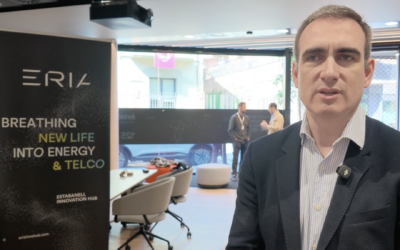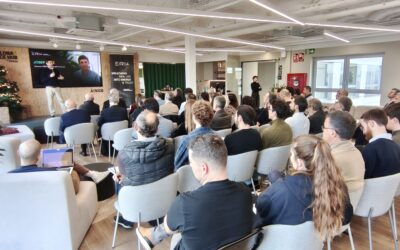


Jesús Buenafuente directs the Catalonia Trade Investment Office in Silicon Valley, where he supports Catalan companies in their entry and growth in the United States and connects the Catalan ecosystem with major technological trends. In this interview with ERIA, he discusses the challenges of breaking into the U.S. market, the perception of Catalonia as an innovation hub, and the growing prominence of energy, networks, and storage in the era of AI.
1. What is the mission of the Catalonia Trade Investment Office in Silicon Valley, and how do you support Catalan companies looking to grow in the United States?
Our mission is to connect Catalan companies with the world’s leading technological innovation hub. We do this in two directions: on one hand, we help startups and innovative companies validate the market, land, and grow in the United States. On the other, we act as an innovation antenna so that the Catalan business landscape can learn firsthand about the trends and technologies that will shape the future. In parallel, we also work very proactively to encourage U.S. companies to invest and create jobs in Catalonia.
2. What is the profile of the Catalan startups that arrive in Silicon Valley? What stage are they in, and what objectives do they usually pursue?
They are technological startups that have already validated their product and have clients in Europe and Latin America, often after a seed or Series A funding round. B2B software, applied AI, digital health, and deep tech companies predominate. Most are born global: they plan to operate internationally from day one. And they have a very clear differentiation that often stems from years of R or their connection with research centers like the Barcelona Supercomputing Center and Catalan universities. Furthermore, AI is usually a central piece of their product and operations.
3. What are the main challenges Catalan startups face when trying to enter or consolidate themselves in the U.S. market? How do Americans see us—do they trust us?
The first is underestimating the size and complexity of the market: the U.S. has a population similar to that of the EU and is not a single market; rather, each state is different, so you need to know where and to whom to sell first. The second is the narrative: you are competing with thousands of international companies, and you must explain very clearly what problem you solve and why you solve it better than your competition. The third is commitment: to succeed, you need to have boots on the ground, often with a founder based here. Consequently, resources are needed to withstand sales and investment cycles that are usually very long. Finally, you must have the ability to pivot and integrate market feedback very quickly. Slack is a good example: they developed a video game that didn’t work, but the chat tool they had created for internal coordination ended up being the product the market demanded.
Regarding trust, we start from a good technical reputation. European startups are seen as solid, with very good engineering teams and powerful products. The doubt Americans have is not whether we know how to build technology, but whether we are serious. An American investor or client will wonder if the company will stay in the U.S., if it will have a team here, if it can provide customer support during local hours, and if it will be ambitious enough. This trust is earned through recommendations from other American companies, investments from local VCs, a corporate structure that is familiar to them (often a Delaware C-Corp), and, above all, by having someone from the team working in the country.
4. What perception does the Silicon Valley ecosystem have of Catalonia as an innovation hub and as a source of talent and startups?
Traditionally, most Americans have associated Barcelona with tourism, Gaudí, Barça, and gastronomy. Catalonia, as a brand, is less known than Barcelona. However, this is changing. Within the Silicon Valley tech community, Barcelona is known as one of the most dynamic startup hubs in Europe, and Catalan talent, especially technical and scientific, is highly valued. There is a large community of Catalan professionals working at big tech firms and startups in Silicon Valley.
As an example of what I am mentioning, Barcelona is the third city in the world for attracting foreign investment in AI, behind only London and Singapore, and the first in the EU. The challenge is to move from being “a great place to live and hire” to being “the place where global companies are born.”
5. What differentiates Silicon Valley from other international innovation ecosystems, especially regarding the relationship between startups, corporations, universities, and investors?
The density of connections and the speed at which talent, ideas, and capital circulate. Stanford University is the classic example, as its alumni network produced HP, born in a Palo Alto garage, and Google. Large corporations don’t just buy technology; they invest in startups through their funds, such as NVIDIA’s. Accelerators like Y Combinator, which saw the likes of Airbnb and Stripe, or Plug and Play act as bridges between all these actors. Furthermore, capital is recycled: successful founders become investors and mentors for the next generation. The “PayPal Mafia,” which later drove Tesla, LinkedIn, and YouTube, is the best-known case.
On the other hand, the culture is very open, and people share information, contacts, and feedback without expecting anything in return. And the high tolerance for failure found here is difficult to find elsewhere. In fact, having closed several companies is valued very positively, as it is understood that experience has been gained and lessons have been learned from mistakes.
6. Beyond AI, what technological or business trends are setting the agenda in Silicon Valley and do you believe will have the most impact in the short term?
We are seeing a lot of investment in robotics and “physical AI,” mainly in robots that work in real-world environments. Waymo, Zoox, and Nuro operate autonomous vehicles and are growing rapidly. There are even startups like Tau Robotics offering home cleaning robots.
I would also highlight energy, driven by the electricity demand of data centers, which has put the grid, storage, and sources like geothermal or advanced nuclear back at the center of the debate.
Defense technologies are gaining a lot of weight, and not just in the U.S.
7. What role does energy play in the AI sector?
AI has turned access to electricity into a bottleneck, and interest in grid management, storage, and the digitalization of distributors has skyrocketed. For Catalan companies and startups in the sector, this is a window of opportunity because European knowledge in renewable integration and smart grids is highly valued here. We see that U.S. utilities are looking for solutions to modernize.
8. Can you share an example or lesson learned from Catalan companies that have successfully leveraged their connection with Silicon Valley?
Kompyte is a good example. Through ACCIÓ, this Catalan startup participated in the TechCrunch Disrupt fair in San Francisco. It raised $150,000 and entered the American accelerator 500 Startups. In 2022, it was acquired by Semrush, which ended up opening a hub in Barcelona. At ACCIÓ, we continue to organize an annual mission of 10 Catalan startups to TechCrunch Disrupt.
The lesson would be that Silicon Valley rewards consistency and presence. And the Catalan presence in California is not just technological; it has historical roots. Freixenet established itself in Sonoma in the eighties with Gloria Ferrer, and Codorníu had the Artesa winery. Torres created Marimar Estate in Sonoma in 1986. In the health industry, Grifols has production plants in Los Angeles and Emeryville and more than 13,000 employees in the U.S. The underlying message is that Catalan companies that succeed here do so with a long-term vocation and local roots.
9. What advice would you give to a Catalan startup considering making the leap to the United States for the first time?
Come here in person. The U.S. and, in particular, Silicon Valley are deeply relational environments, even if it doesn’t seem so from the outside. Trust is built over coffee, attending events, or having face-to-face meetings. If investors or clients don’t see you, it is practically impossible to open a market or raise a funding round from a distance. We always recommend that at least one founder comes to spend time here, not just for occasional visits or fairs. For example, August is a good month to come: it is a quiet time in Catalonia, but active in the U.S.
From there, you need to have a pitch and all commercial materials adapted to the U.S. market, a corporate structure designed to grow here, and, above all, patience. And don’t do it alone: the ACCIÓ network and the Catalan community in the U.S. are here to help.