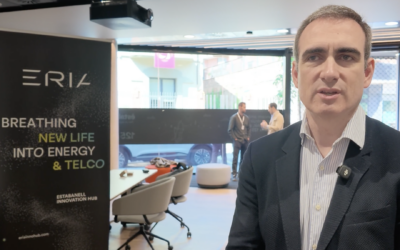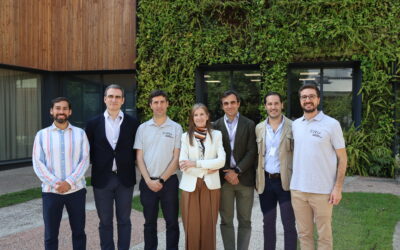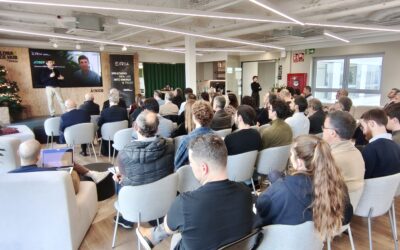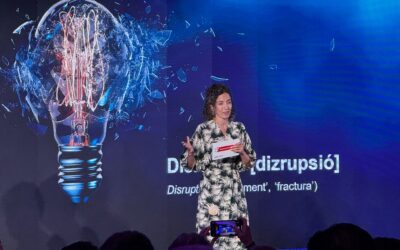


After years working in innovation and entrepreneurship from the public administration, and today as a business angel, mentor and teacher, Lluís Juncà offers a cross-sectional view of the Catalan startup ecosystem. In this interview for ERIA he reflects on the most common mistakes of startups, the importance of the founding team, the relationship with capital and the major trends that will mark the future of entrepreneurship.
1. From your experience as a mentor in ERIA programs and others, what are the most common mistakes that startups make in their early stages?
One of the most common mistakes I see in the early stages is spending too much time developing and perfecting the product or service and too little time validating it in the market. This is especially common in teams with a very technical profile, where there is a tendency to perfect the solution from a technological point of view, but relatively little time is spent talking to customers, testing hypotheses, or really understanding whether what is being built solves a relevant problem.
2. What do you mainly look for when deciding to invest as a business angel: the team, the business model or the market timing?
These three variables are important and, in reality, the decision to invest is always a combination of all of them. However, if I had to highlight one, it would clearly be the team, and in particular, the founder or leader. They are the ones who set the tone, culture and execution capacity of the company. The business model can evolve, it can pivot. The market moment can also change or adapt. But all of this depends on the ability of the team, and especially its leader, to make decisions, learn quickly and correct mistakes.
3. According to the maxim “if you don’t believe in the person, don’t invest in them”, how do you value this human factor in practice?
I think it’s one of the most important principles in early-stage startups: the person is the company. When you’re investing in a startup that’s just starting out, you’re not investing in a consolidated organization, or in a defined business culture, or in established processes. You’re essentially investing in a person or a small team. So if you don’t believe in that person—in their ability, their judgment, their resilience—it’s very difficult to justify an investment.
4. What are some examples of startups that have left the biggest impression on you as an investor or mentor, and why?
As a mentor, the startup that has left the biggest impression on me is Wattium, led by Roger Casals, and which formed part of the ERIA acceleration program. I think it is a very good example of the type of company that we would like to see more of in Catalonia: a deeply technological startup, with a lot of added value, in a strategic sector such as energy, and with a clear ambition to compete on a global scale. As an investor, the experience that has left the biggest impression on me is probably Kleta, which was one of my first relevant investments. It was not a successful investment in financial terms, but it was very valuable in terms of learning. It allowed me to understand first-hand the importance of factors such as the business model, the relationship between founders or the ability to adapt to new competitors.
5. How has the Catalan entrepreneurial ecosystem changed in recent years, especially since your time in public administration until now?
What I have seen in recent years is a progressive evolution towards a more mature and sophisticated ecosystem. There has not been an abrupt change, but rather a continuous improvement in many areas. For example, the number of startups has grown steadily, around 7–8% per year. Today in Catalonia there are around 2,400 startups, whereas a decade ago there were less than half. There are also more and more specialized investment funds, more business angels, more investment networks and more involvement of large companies in innovation. In this sense, the ecosystem has gained muscle, structure and notoriety, and this is clearly good news. However, I also believe that this evolution is still insufficient if we compare ourselves with the best. Ecosystems like Berlin, London or Paris are still a few steps ahead in many aspects. Therefore, we must avoid complacency and always look towards the most demanding benchmarks.
6. In your newsletter you often talk about the meaning of money. How should a startup approach its relationship with money in the early stages?
In the early stages, money is important, but it must be managed very judiciously. It is important because, obviously, it facilitates the development of the project: it allows you to hire a team, advance the product and sustain the day-to-day running of the company. However, it can also be a risk if it is not managed well. A common mistake is to raise more money than is really needed. When a startup has an excess of capital, it can lose focus, efficiency and that positive tension that forces it to prioritize and execute better. Furthermore, raising too much capital too soon often implies a high valuation that is then difficult to sustain. And an overvalued company has, in the long term, a more complicated path. Therefore, the key is to find a balance: raising the resources necessary to move forward, but maintaining discipline, efficiency and healthy growth.
7. Many entrepreneurs associate success with rapid growth or raising capital. How would you define the success of a startup?
I would define the success of a startup as the ability to find a product or service that the market really wants and be able to quickly scale it in sales with still very large growth potential. In other words, success is not about raising capital, but about growing sustainably through customers and revenue, within a truly scalable model. If there is no room for growth, you may have a good company, but it will hardly be a startup in the strict sense. Raising financing can be useful, but it can also be a trap. There are companies that raise a lot of capital and end up not working, and others that, without raising much, build solid and profitable businesses.
8. In a context of economic uncertainty and inflation, what decisions do you think are key to the survival of a startup?
Economic uncertainty is, in a way, inherent to any startup. In fact, starting a business already involves operating in an environment of constant uncertainty, and that is why good teams tend to be prepared to manage it. In this sense, macroeconomic uncertainty is not necessarily an added problem, but is often part of the game itself. It can even be seen as an opportunity: in less stable environments, new needs, changes in behavior and spaces to innovate appear. That said, it is key to be very rigorous in financial management. Aspects such as liquidity, debt or cost control become especially critical in contexts of inflation or volatility. Therefore, more than avoiding uncertainty, the key is knowing how to live with it and manage it well. And, in many cases, a well-prepared startup can even emerge strengthened from these environments.
9. You also talk about the importance of “defining your game” in finance. How can startup founders apply this concept?
When I talk about “defining your game” I mean the idea that there is no single right way to do things, both in finance and in running a startup. It is clear that you need to learn from others, observe what works and what doesn’t, and understand previous experiences. But in the end, the most important thing is to be able to make your own synthesis and build a strategy that makes sense for you and for the project you are leading. Copying models or decisions from others can be useful as a starting point, but it often leads to suboptimal strategies. A startup needs conviction, consistency, and long-term energy, and this is only possible if the founder feels truly identified with the path they have chosen.
10. Looking to the future, what sectors or trends do you think will mark the next generation of startups?
I believe that there are at least three major trends that will shape the next generation of startups. The first is obvious: artificial intelligence. We are in a new wave of innovation deeply conditioned by AI as a transformative technology, and this is already translating into the creation of many startups that have AI as a central lever of value. The second, which may seem contradictory but is actually complementary, is the return to hardware and industrial capacity. Especially in Europe, there is a clear awareness of the need to recover technological and productive sovereignty. This implies building tangible things again: from energy technology to industrial systems or dual-use technologies linked to defense. And the third trend is, in a way, a reaction to AI: the growth of projects that generate value in areas that are difficult to replace with technology. I am talking about human experiences, culture, identity, gastronomy or creativity. Therefore, the future will not be just digital: it will be a combination of artificial intelligence, reindustrialization and human experiences.