
In recent years, home batteries have been mainly associated with photovoltaic installations. Their function was clear: to store solar surpluses for use when production decreased.
But this view leaves out a large portion of the residential market.
Most Spanish households do not have their own photovoltaics. Many live in multi-family buildings, have limited space or cannot afford the investments necessary to fully electrify their homes. However, these households could also benefit from new forms of energy storage.
This raises an interesting question: what should a battery designed for the mass market look like?
The answer is probably very different from the solutions that dominate the market today.
Batteries for the mainstream residential market should be more compact, more affordable and easier to install. They should be suitable for homes with contracted power between 3 and 7 kW, moderate consumption and limited available space.
They should also respond to different needs.
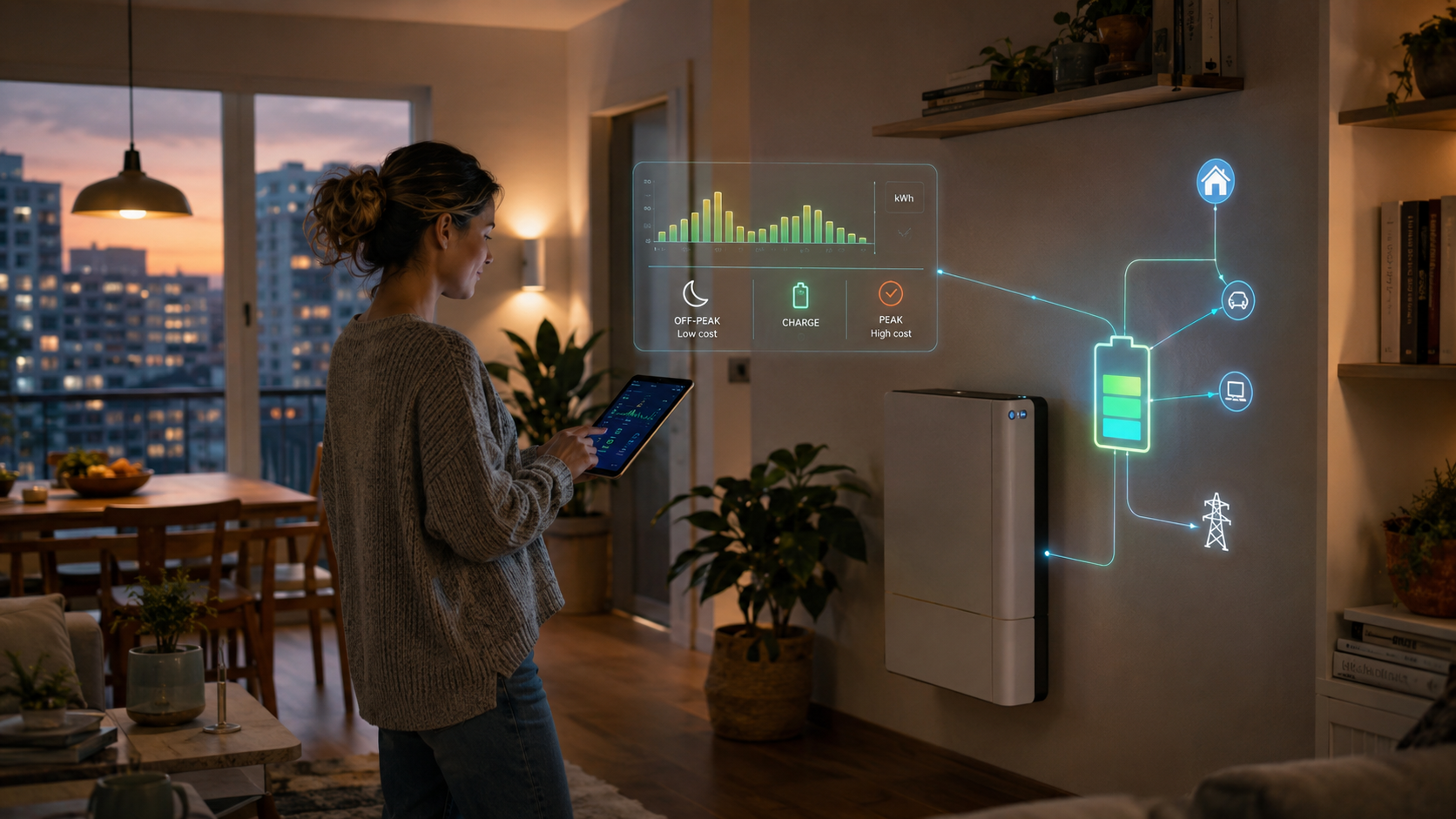
Without photovoltaics, the value of a battery cannot be based exclusively on self-consumption. Other use cases need to be explored: tariff optimization, shifting consumption between time slots, reducing peak demand, partial support in the event of incidents or preparation for future flexibility services.
This change in perspective is important. The battery ceases to be presented as a tool for energy self-sufficiency and becomes an instrument for control and optimization.
But for this to be viable, it is necessary to go beyond the usual commercial messages.
The metrics that really matter are not just the nominal capacity or the estimated monthly savings. You also need to analyze how many kWh are moved annually, how many useful cycles the battery performs, what is the real cost per cycle and what value it provides in each use.
This approach allows for a more rigorous assessment of whether a given solution is capable of generating sustainable value for the customer.
Naturally, significant barriers still exist.
The first is economic. Although battery costs have decreased significantly in recent years, they continue to represent a significant investment for many families.
The second is commercial. Many consumers continue to associate batteries exclusively with photovoltaics or backup. Building a different value proposition requires education, communication and easy-to-understand user experiences.
The third is regulatory and market. Residential flexibility mechanisms are still in an initial phase of development and progress will be needed in aspects related to the aggregation, measurement and valuation of distributed resources.
That’s precisely why it’s interesting to start experimenting now.
That’s precisely why it’s interesting to start experimenting now.
Exploring compact batteries is not simply about reducing the size of an existing product. It means rethinking the cost, installation, business model, associated services and their integration with other present or future energy resources.
At ERIA InnoHub, we believe that this is one of the areas with the most potential for the coming years. Not because every home needs a battery today, but because understanding what characteristics these solutions should have will help us build products adapted to the reality of the residential market.
The big question is not whether batteries will play a role in the energy transition. The question is which batteries will be able to reach the millions of homes that are not yet part of the most advanced energy model. Finding that answer is precisely one of the challenges we want to explore.